
India's trade deficit with Russia continued to widen for the second consecutive year to $57 billion in the financial year 2023-24 (FY24), with Moscow becoming New Delhi's largest source of crude oil imports. All eyes will now be on Prime Minister Narendra Modi's visit to Russia during July 8-9, where he is set to meet President Vladimir Putin. This will be Modi's first visit to the Kremlin since the Russia-Ukraine conflict began over two years ago.

India's crude oil imports from Russia fell for a second straight month in January to its lowest in 12 months but the nation's insatiable appetite for Russian crude remains for the long term, according to data from energy cargo tracker and industry officials. Russia supplied 1.2 million barrels per day of crude oil to India in January, down from 1.32 million barrels in December and 1.62 million barrels in November 2023, according to data from energy cargo tracker Vortexa. Russia however continues to remain India's top oil supplier, accounting for a little less than a quarter of 4.91 million barrels a day of oil that the world's third largest energy consumer imported in January.
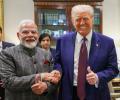
'I look forward to speaking with my very good friend, Prime Minister Modi, in the upcoming weeks.'

Stressing that wars are "very bad", Trump said that he seems to have "an ability to end them, to get people together" for which he uses the "power of the United States".
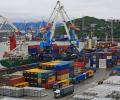
India's exports rose 6.7 per cent to $35.1 billion in August annually, while imports declined 10.12 per cent to $61.59 billion, according to government data released on Monday. Gold imports were down nearly 56 per cent in August, helping to trim merchandise trade deficit to $26.49 billion in August, as against $35.64 billion in the year-ago month.

Russia has welcomed India's decision to not support the price cap on Russian oil announced by G7 and its allies and offered it cooperation on leasing and building large-capacity ships to overcome the ban on insurance services and tanker chartering in the European Union and Britain to continue buying discounted oil. The offer came as Russian Deputy Prime Minister Alexander Novak held a meeting with the Indian Ambassador to Moscow, Pavan Kapoor, on Friday. "The Deputy Prime Minister welcomed India's decision not to support the price cap on Russian oil, which was imposed on December 5 by the G7 countries and their allies," the Russian foreign ministry said in a statement.
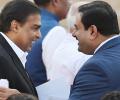
Who else will take on the might of Microsoft, Google, and Amazon if not the Adanis, Ambanis, Birlas, or Tatas?, asks R Jagannathan.
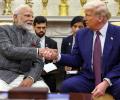
Amid trade tensions between Delhi and Washington, the NYT article gives an account of how relations between Trump and Modi "unraveled" after Trump's repeated claims of solving the four-day conflict in May between India and Pakistan, an assertion denied by India.
'There is definitely tepid demand because of the (reciprocal tariff) uncertainty.'
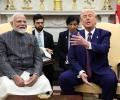
Deferment or rescheduling of the meeting assumes significance as the US has announced a staggering 50 per cent duty on Indian goods.

Trump's new rules for how countries should treat him have led to the current breakdown in India-US relations, explains Ambassador T P Sreenivasan.
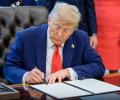
The collective West has always opposed strong leaders and economic development in India, asserts Colonel Anil A Athale (retd).
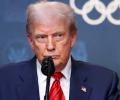
United States President Donald Trump has said there will be no trade negotiations with India until a dispute over tariffs is resolved, following his administration's decision to double tariffs on Indian imports.
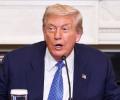
Donald Trump's tariffs, meant as political punishment, have avoided the predicted chaos, lifting US growth, weakening rivals, and letting him claim victory in a resilient global economy, observes T T Ram Mohan.

Indian manufacturing sector witnessed the fastest improvement in operating conditions in over 17 years in August, driven by an increased production efficiency and healthy demand conditions, a monthly report said on Monday. The seasonally adjusted HSBC India Manufacturing Purchasing Managers' Index (PMI) rose from 59.1 in July to 59.3 in August, indicating the fastest improvement in operating conditions for 17-and-a-half years.

A meeting with Chinese President Xi Jinping on the sidelines of the SCO summit is being planned.

By threatening to punish India with high tariff, Trump is actually planting a tantalising thought in the Indian mind that the Modi government should suitably 'incentivise' him, explains Ambassador M K Bhadrakumar.

India has said it will take all steps to protect its national interests and ensure comprehensive national security in all domains after Pakistan and Saudi Arabia signed a strategic defence pact.

'The biggest point of contention is market access for US agricultural and dairy products.'

The way to deal with a bully is to resist bullying, because submission in the first instance only invites even more overbearing demands in future. What may seem like a small price to pay now will lead to a much higher price later, warns former foreign secretary Shyam Saran.

New Delhi has reached out to Moscow while waiting for a new president in Washington. New Delhi knows well that in international relations, there are no permanent friends or foes, only permanent national interests, points out Dr Rup Narayan Das.

Putin further described the Ukraine conflict as a mere "pretext" by Western powers to take these broader punitive measures against countries maintaining strong economic ties with Russia.
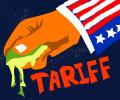
'If the near-term economic pain is absorbed more by those who have the ability and the financial strength to do so, then small and medium enterprises in downstream industries will emerge stronger from the trade imbroglio.'

Puri said the government has a moral duty to provide energy at affordable rates to consumers.

'America holds about 16% of IMF voting rights, giving it crucial influence over Pakistan's desperately needed bailout loans.'

The oil industry experienced three upheavals between 1973 and 1991, which seem to be etched in the memory of the industry's decision makers. Naturally, at the sign of a new crisis, the decision makers like to dip into those tumultuous decades to find ways to deal with the new shock, in addition, of course, to expert reports and forecasts. So, the industry bigwigs turned the pages of history to get a peek into the future of oil price movements after Russia invaded Ukraine in 2022, Israel attacked Gaza in 2023, Iran-linked Houthi rebels pounded tankers crossing the Red Sea in support of Palestine the same year, and Iran rained missiles on Israel in 2024.
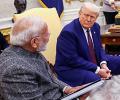
The Indian government is studying the implications of US President Trump's announcement to impose tariffs on Indian goods and remains hopeful of concluding a bilateral trade agreement.

From labelling India the 'Tariff King' to slapping sweeping import duties, US President Donald Trump has steadily hardened his trade stance on India. These announcements are being seen as a pressure tactic to get New Delhi to agree to demands made by the US in the proposed Bilateral Trade Agreement (BTA).

Uttar Pradesh's leading export hubs are reeling under the impact of a steep 50 per cent tariff imposed by the US on Indian imports, with exporters warning of job losses, stalled orders and shrinking market access. Industry leaders from Noida, Kanpur and Varanasi said the tariff has put years of painstaking market-building at risk, even as protests and demonstrations erupted in several districts last week.

Urals and Sokol accounted for every 4 out of 5 barrels of Russian supplies to India last year.
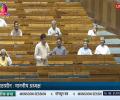
Commerce Minister Piyush Goyal assures Parliament that India will take necessary steps to protect its national interests following the US announcement of tariffs on Indian goods. The government is assessing the implications and engaging with stakeholders.

GST 2.0 may cushion consumers against US tariffs, but like the 2019 corporate tax cut, it risks being another tactical fix rather than a structural growth strategy, expects Debashis Basu.

India will take all necessary steps to safeguard and promote national interest, Commerce and Industry Minister Piyush Goyal said on Thursday, a day after US President Donald Trump announced 25 per cent tariffs plus penalty on domestic exports to America from August 1.
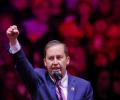
'For the most populous Region in the World, it is important that I have someone I can fully trust to deliver on my Agenda and help us, MAKE AMERICA GREAT AGAIN.'

India and Russia on Tuesday set a target of $100 billion in annual trade volume by 2030 and vowed to develop a robust bilateral payment settlement mechanism using national currencies. The two sides also inked a total of nine agreements to further broadbase cooperation in a range of areas including in the economic domain following summit talks between Prime Minister Narendra Modi and Russian President Vladimir Putin.
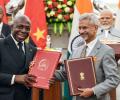
India's External Affairs Minister S Jaishankar has called on Europe to display sensitivity and mutuality of interest for deeper ties with India, stating that New Delhi seeks partners, not "preachers." Jaishankar emphasized the importance of "Russia realism" in India's foreign policy, highlighting the natural complementarity between India and Russia as a resource provider and consumer. He criticized attempts by the West to address the Russia-Ukraine conflict without Russia's involvement, arguing it "challenged the basics of realism." Jaishankar also stressed the importance of finding common ground with the US, suggesting that focusing on mutuality of interest rather than ideological differences is key to successful engagement.

The Bloomberg report suggests that this backchannel communication from President Xi has laid the groundwork for a broader thaw in relations. This overture has since translated into a series of tangible diplomatic actions leading up to the upcoming Shanghai Cooperation Organisation (SCO) summit.
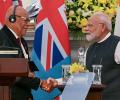
Fijian Prime Minister Sitiveni Rabuka discussed US tariffs on Indian goods with Prime Minister Narendra Modi, noting that "somebody is not very happy with you." The discussion occurred during Rabuka's visit to India to strengthen ties.

Equity markets this week will turn their focus on the RBI's interest rate decision, Q1 earnings from several blue-chip firms and tariff-related news for further cues, analysts said. Moreover, trading activity of foreign investors and trends in global equity markets will also drive investors' sentiment.
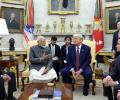
'As one former Indian diplomat put it to me, Delhi has access to the White House, but Islamabad has access to Mar-a-Lago.'
